Management Report
Resilience in turbulent times
The 2025 financial year was another challenging one for the SFS Group. As in the previous year, our end markets were characterized by enormous uncertainty and a reluctance to invest. We generated CHF 3,056.6 million in sales and achieved an adjusted EBIT margin of 12.2% due not only to our broad positioning across different end markets and regions but also the extraordinary commitment of our employees. This was also a key factor in the major progress we made in the area of sustainability.
_width-1240.jpeg)
Dear Shareholders,
The 2025 financial year proved to be another intense year against the backdrop of an adverse market environment. Uncertainty remained high in the end markets and reluctance to invest continued to put a damper on market momentum. Excess capacity, particularly in the automotive industry and industrial manufacturing in Europe, has caused demand to drop.
Ongoing political and economic upheavals as well as the continued appreciation of the Swiss franc made it necessary to take proactive steps. In the 2025 financial year, SFS introduced a program to streamline the global production and distribution network with the goal of aligning production capacities with partially reduced customer demand and strengthening the focus on our core activities.
In the Engineered Components (EC) segment, SFS successfully made major progress in all end markets and continued its positive development. The Fastening Systems (FS) segment continued to be characterized by subdued demand, with the North American construction industry proving more dynamic than its European counterpart. In the Distribution & Logistics (D&L) segment, volumes remained at the previous year’s level despite lower customer willingness to invest. With its planned acquisition of three partner companies – Gödde GmbH, Oltrogge Werkzeuge GmbH and Hch. Perschmann GmbH – by the end of March 2026, the SFS Group will be able to consolidate its market position in the trading business.
The SFS Group succeeded in achieving the financial targets thanks to its broad positioning across different end markets and regions as well as the measures implemented to boost profitability. Major investments made in the past few years continued to have their intended impact and contributed significantly to the overall results, while the local-for-local strategy systematically leverages opportunities arising from changing framework conditions.
SFS generated sales of CHF 3,056.6 million and growth of 0.6% in the 2025 financial year. Currency effects reduced sales growth by –2.9%. Organic growth amounted to 2.9%.
Solid financial basis
Profitability was impacted by occasionally low capacity utilization as well as non-recurring effects arising as a result of changes to the production and distribution network. Adjusted for these non-recurring effects, operating profit (EBIT) came to CHF 371.0 million, which corresponds to an adjusted EBIT margin of 12.2% (PY 11.6%). Operating profit (EBIT) including non-recurring effects declined to CHF 324.3 million (PY CHF 350.2 million) at an EBIT margin of 10.6% (PY 11.6%). Net income amounted to CHF 220.2 million (PY CHF 242.7 million) or 7.2% (PY 8.0%) of net sales. The SFS Group generated an excellent operating free cash flow of CHF 273.6 million (PY CHF 226.1 million). Earnings per share (EPS) amounted to CHF 5.63 (PY CHF 6.21) and were burdened by both the economic environment and the non-recurring effects. The equity ratio rose to 64.4% (PY 59.7%) – a clear indicator of financial strength.
The completion of several major projects and the focus on optimizing capacity utilization led to a significant decline in investments in buildings, equipment, hardware, and software, which amounted to CHF 103.7 million (PY CHF 148.9 million). Research and development expenses decreased to CHF 68.5 million (PY CHF 76.0 million), as key projects are nearing completion. They were charged in full to the income statement.
Sustainability is a priority at SFS. Significant ESG (Environment, Social, Governance) improvements were made in the reporting year.
Environment: Interim targets achieved ahead of time
The SFS Group successfully advanced the implementation of its climate strategy. Scope 1 and 2 greenhouse gas emissions were reduced by –9.9% versus the previous year. Compared to the 2020 reference year, this equates to a reduction of –77.1% in relation to net sales. A slight decline was also recorded for Scope 3 emissions. The climate targets for 2050 are consistent with the 1.5 °C target set by the Science Based Targets initiative (SBTi) and were validated at the end of 2025. The share of renewable electricity exceeded the interim target for 2025 significantly, totaling 81.5%
Social: Accident rate improved, number of potentially critical suppliers reduced
In the 2025 financial year, SFS made considerable progress in the area of occupational health and safety. The accident rate was lowered to 2.9 accidents per million working hours (PY 4.2). Standing at 5.9%, the share of permanent employees enrolled in dual education and training programs was once again within the target range of 5–7%.
With the aid of risk analyses, ESG monitoring and the mandatory Supplier Code of Conduct, the SFS Group reduced the number of potentially critical suppliers to 249 (PY 621) and increased the level of transparency in the value chain.
Governance: Moral and value-based corporate governance
The updated Code of Conduct for employees was implemented in the reporting year by means of trainings and internal audits. In the reporting year, no compliance violations resulting in fines or legal proceedings were recorded. Likewise, no incidents of corruption or bribery were reported. Furthermore, the company was not made aware of any human rights violations, including incidents of child labor, within its sphere of influence in 2025.
13,646 Value Creators
The SFS Group had 13,646 employees (FTEs, PY 13,689) around the world as at December 31, 2025.
Systematic risk assessments
The Group Executive Board and the Board of Directors perform regular assessments of the Group’s most important business risks. Potential threats are thoroughly assessed at least once a year based on their likelihood of occurrence and loss amount.
Potential risks and appropriate mitigation measures were discussed again in detail during the reporting year. These discussions focused on the SFS Group’s dependency on the global economic environment and geographic shifts in demand; currency fluctuations; geopolitical instabilities; data breaches and business interruptions due to cyber attacks or disruptions in global supply chains; natural disasters; and increasing regulatory requirements. Measures to mitigate these risks are being examined and implemented on an ongoing basis.
Changes in the Group Executive Board
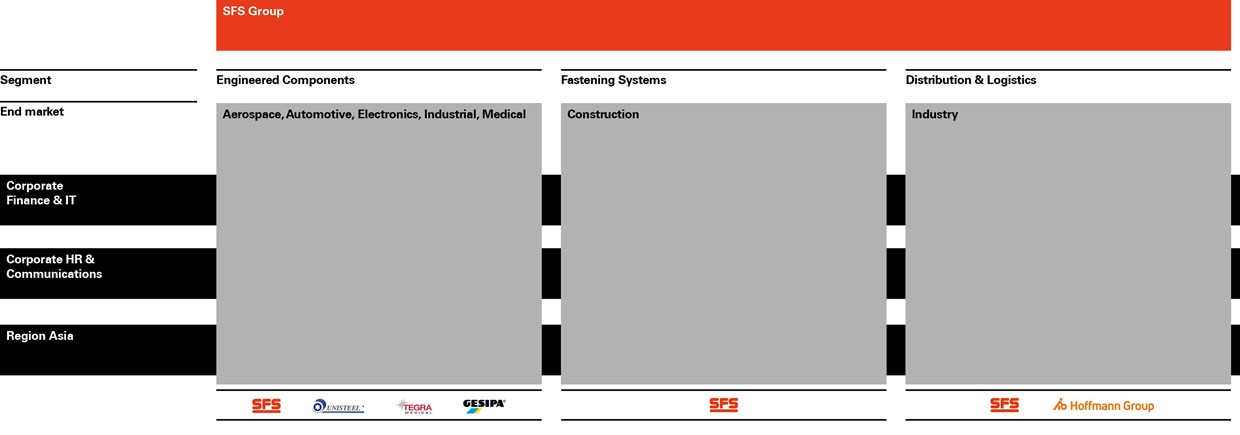
The SFS Group made changes to its organizational structure and restructured its FS and D&L segments as of January 1, 2025. These efforts were aimed at sharpening the Group’s focus on selected end markets, streamlining its decision-making processes and strengthening collaboration among the segments. Thomas Jung, previously Head of Region North America in the Construction division, has been Head of Segment FS since the start of 2025. Martin Reichenecker, previously Head of Division D&L International, took over responsibility for the D&L segment on January 1, 2025. Iso Raunjak, previously Head of Division D&L Switzerland, took on the role of Head of Corporate HR, Communications & ESG.
Against this same backdrop, the divisions in the EC segment were disbanded as at January 1, 2026, and the responsibilities were reassigned according to application areas. To strengthen and further develop all business areas in the Asian growth market, SFS has additionally merged them into the new Region Asia. Urs Langenauer, previously Head of Division Automotive, has been put in charge of the EC segment within the context of these changes. Martin Reichenecker took on the role of Head of Region Asia as of January 1, 2026. Iso Raunjak succeeded Martin Reichenecker at the helm of the D&L segment. Christina Burri strengthens the Group Executive Board in her role as Head of Corporate HR, Communications & ESG.
Changes in the Board of Directors
There were no changes in the Board of Directors during the 2025 financial year. No proposals for changes are planned for the 2026 Annual General Meeting either.
Looking ahead to the 33rd Annual General Meeting on April 22, 2026
The next Annual General Meeting of SFS Group AG will be held at Sportzentrum Aegeten in Widnau (Switzerland) on April 22, 2026. The Board of Directors proposes the payment of a dividend in the amount of CHF 2.50 per share (PY CHF 2.50), of which CHF 0.50 is to be distributed from the statutory capital reserve. CHF 2.00 will be paid from retained earnings. Further details will be provided with the invitation in March 2026.
Outlook for the 2026 financial year
The outlook is still characterized by considerable uncertainty. Against this backdrop, the Group will continue to focus on its rigorous customer orientation, pushing ahead with innovation projects and ensuring efficient and profitable business processes. We will steadfastly continue to pursue and implement the global production and distribution network streamlining program introduced in the 2025 financial year.
For the 2026 financial year, the SFS Group is focusing on the mid-term guidance and expects sales growth in local currencies, including scope of consolidation effects, of 3–6% as well as an adjusted EBIT margin of 12–15%.
Thank you
We would like to extend our gratitude to each and every employee at the SFS Group for their commitment, expertise and innovative energy, which were pivotal to SFS’s good results and successful development in the reporting year.
We would also like to thank our business partners for the trusting and constructive collaboration that enables us to work together to create solutions with lasting added value.
Thanks go to our shareholders, as well, for their loyalty and the trust that supports the SFS Group’s long-term development.
_width-1240.jpeg)
Thomas Oetterli
Chair of the Board of Directors

Jens Breu
CEO